Quick answer
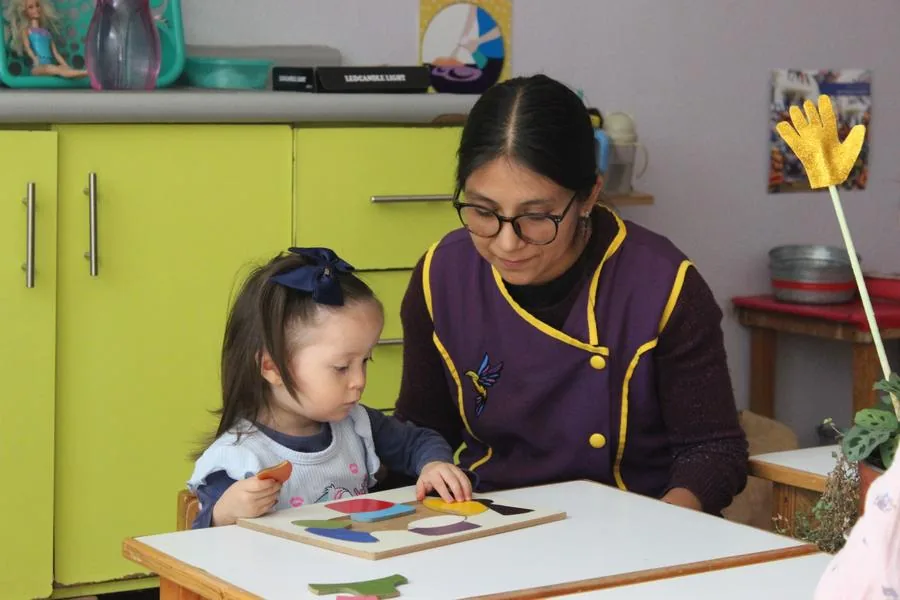
The Montessori method is an educational approach created by Dr. Maria Montessori in the early twentieth century. It starts from a simple idea: children learn by themselves, choosing activities with concrete materials within a prepared environment, while an adult observes and guides them instead of giving one lesson to everyone.
The essentials
- It was created by Maria Montessori, an Italian physician and educator.
- Children choose their work and repeat it as many times as they need.
- The classroom is prepared: order, materials within reach and child-sized furniture.
- The adult observes and guides; they do not dictate the lesson.
- It is organized by stages: ages 0 to 3 and ages 3 to 6.
In this article
- Who was Maria Montessori?
- What are the principles of the Montessori method?
- What is a day like in a Montessori classroom?
- What is the difference between the 0 to 3 and 3 to 6 stages?
- What is the adult's role in the Montessori method?
- Common myths about the Montessori method
- How do I know if the Montessori method is right for my child?
- Frequently asked questions
Who was Maria Montessori?
Maria Montessori was born on August 31, 1870 in Ancona, Italy. She was a physician, scientist, psychiatrist, philosopher and humanist, and the first Italian woman to earn a medical degree. She graduated from the Sapienza University of Rome in 1896.
She began working in the university's psychiatry department and became interested in the education of children with learning difficulties. By observing how they responded to concrete materials, she developed a pedagogy based on the child's freedom and on observation. In 1907 she opened her first Casa dei Bambini (Children's House) in Rome. She died on May 6, 1952 in the Netherlands.
The guide presents the material calmly and then lets the child work on their own.
What are the principles of the Montessori method?
Although each school has its own style, the principles that support the method are the same around the world:
- Absorbent mind. Young children absorb knowledge from their surroundings naturally, like a sponge.
- Prepared environment. The classroom is organized by areas, with materials on open shelves and furniture sized for children.
- Freedom within limits. Children choose their activity, but within a clear framework of respect for others and for the space.
- Control of error. The material itself lets children notice whether they made a mistake and try again, without depending on an adult to correct them.
- Autonomy and self-discipline. Children build their independence by doing, not by watching.
- Mixed-age groups. The older children help the younger ones, and the younger ones learn by watching the older ones.
What is a day like in a Montessori classroom?
Instead of a class where everyone does the same thing at the same time, the day is organized around long periods of work. Each child chooses a material, takes it to their table or to a mat, uses it for as long as they need and returns it to its place so another classmate can use it.
Meanwhile, the guide observes, presents new materials to individual children or small groups and intervenes as little as possible. In addition to individual work there are group moments, such as circle time, songs, gardening or movement activities.
What is the difference between the 0 to 3 and 3 to 6 stages?
The method recognizes that needs change with age, which is why it is organized into stages with different environments:
| Ages 0 to 3 | Ages 3 to 6 | |
|---|---|---|
| Usual name | Infant Community (toddler) | Children's House (preschool) |
| Focus | Movement, language, order and first routines of independence | Refining fine and gross movements, language, math and culture |
| Adult's role | Caring for, accompanying and preparing a safe environment to explore | Presenting materials and observing each child's work |
| Learning | Through the body and the senses | Through concrete material that becomes increasingly abstract |
What is the adult's role in the Montessori method?
In Montessori, the teacher is called a guide. Their job is to prepare the environment, observe each child, present the material at the right moment and step back so the child can work alone. They do not reward or punish: they aim for the child to find their motivation in the work itself.
Common myths about the Montessori method
| Myth | Reality |
|---|---|
| "Children do whatever they want." | They choose within a clear framework: there are rules of respect for the materials, classmates and space. |
| "There is no play." | Working with materials is children's form of purposeful play; they experience it with joy. |
| "It's only for very calm children." | The environment is designed to channel energy into meaningful activities, with movement included. |
| "It's the same in every school." | The name is not exclusive to a single institution, which is why it is worth asking about the guides' training and the materials. |
How do I know if the Montessori method is right for my child?
The best way is to watch a classroom in action. Notice whether the children work with concentration, whether the environment is orderly and calm, and whether the adult speaks respectfully and at the children's level. At Montessori Calmecac, a toddler and preschool in San Pedro Cholula that has worked with this method since 2003, you can schedule a visit to see it in person.
Frequently asked questions
At what age can you start with the Montessori method? It can begin in the first years. There are environments designed for children ages 0 to 3 (Infant Community) and ages 3 to 6 (Children's House).
Is Montessori the same as a traditional preschool? No. In a traditional preschool, the teacher usually directs the same activity for the whole group. In Montessori, each child chooses their work with concrete materials and progresses at their own pace.
Can Montessori children adapt to another school later? They can. What they carry with them are habits such as autonomy, concentration and responsibility, which serve them in any setting. Each child has their own pace of adjustment.
Who created the Montessori method? Dr. Maria Montessori, an Italian physician and educator born in 1870, who opened her first Children's House in Rome in 1907.
MC Montessori Calmecac Team
A Montessori toddler and preschool in San Pedro Cholula, Puebla, with roots going back to August 2003. If you want to see how the method is experienced in a classroom, schedule a visit.