Author: Alejandra Galeana, Children's House Guide
INTRODUCTION TO WRITING
- Writing:
Reading and writing are very complex actions that require a wide variety of physical coordination and mental skills. To help children acquire these skills, Dr. Montessori used two principles.
- Indirect preparation: the help we give the child to reach a point, where the arrival will not happen at that moment but in the future.
- Direct preparation: the help we give to develop a specific skill at that moment.
Necessary skills: the child has to develop both manual (physical) and mental skills.
Physical skills:
The child needs muscle development and hand control, which will allow them to achieve:
- Muscle development and hand control
- A light touch
- Development of the coordination of the thumb, index and middle fingers for handling
- Development of the coordination of the hand and wrist muscles to follow a contour with a firm touch
- The ability to trace the shape of letters
- The movement of writing, from left to right; the ability to join letters to form words
- The ability to leave space between letters (physical and mental)
Mental skills:
- Knowledge of the isolated sounds of letters
- Visualizing and naming the letter symbols that correspond to the sound
- Identifying all the sounds in a word
- Visualizing the symbols of those sounds
- Joining these sounds and symbols to form words (this has to do with the mental ability to see where a word ends in order to leave a space and start another)
- Forming sentences in a sequence so that the words make sense; to do this, children need to be in contact with ideas that motivate them to express them in writing.
Preparing the hand through sensorial material:
- Cylinder blocks: when picking up the knob, the same fingers are used that will later hold the pencil
- Rough and smooth boards: prepare for tracing letters
- Geometric cabinet: trains the wrist and hand muscles to follow a shape
Indirect preparation for writing:
- The "I spy" game: the child learns the phonemes that make up their language and becomes aware that a word is a sound composed of several sounds that, on their own, have no meaning
- Metal insets: the inset's frame limits the movement of the pencil; later, the double line will serve as the limit.
Direct preparation for writing:
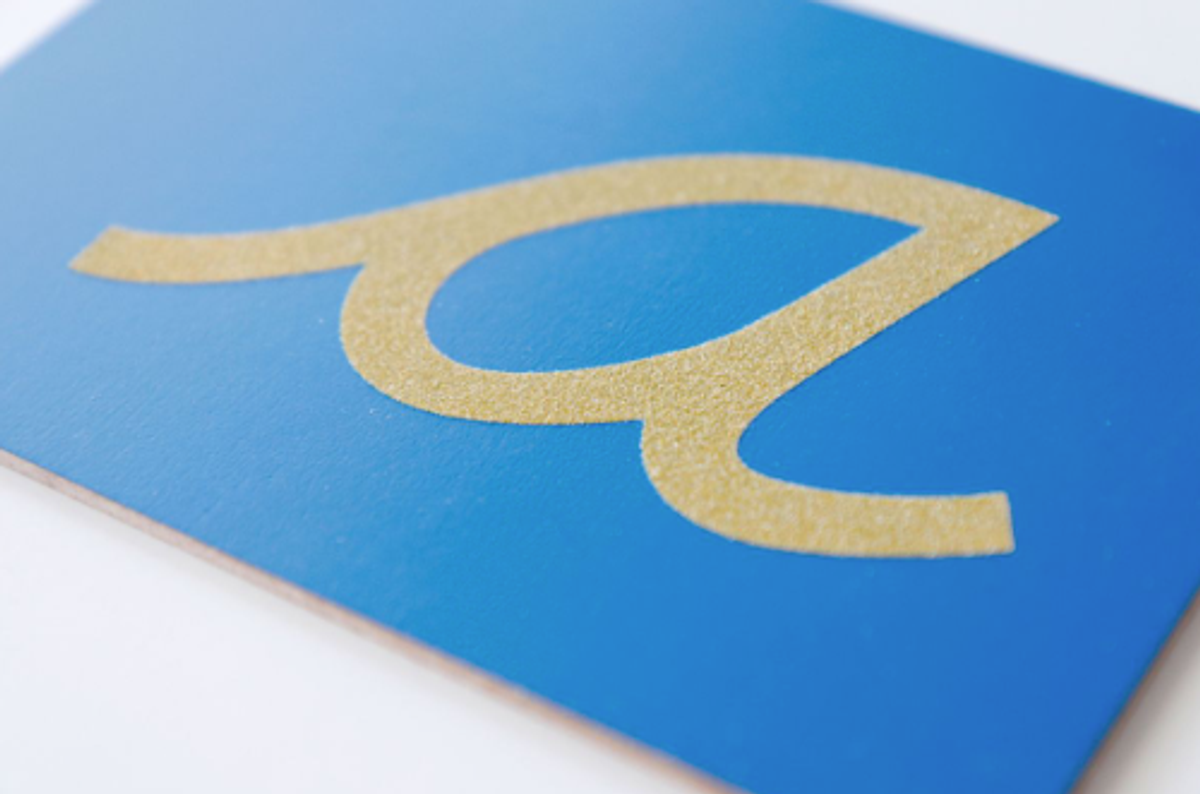
- Sandpaper letters: association of the phoneme with the symbol, and acquiring the muscle skill for tracing letters. The child will obtain information through three sensory channels: sight, touch and hearing
- Moveable alphabet: the child already knows the symbols of the phonemes through the senses; now they will see the phonemes represented in separate letters and realize that putting letters together represents words.
- Writing aids: using a writing instrument, first chalk and then a pencil
Through indirect and direct preparation, the child will develop all the skills they need in order to write. Writing with an instrument will be the culmination.