Quick answer
Practical life is the Montessori area made up of everyday activities such as pouring water, buttoning, folding fabric, sweeping or preparing food. It helps children build independence, concentration, coordination and order by doing real tasks from their surroundings for themselves.
The essentials
- These are real, day-to-day tasks, scaled to the child.
- They develop independence, concentration, coordination and order.
- They are presented slowly, without talking too much, and the child repeats them.
- At home, all you need is a small stool, small utensils and patience.
In this article
- What is practical life in Montessori?
- What is practical life for?
- What types of practical life activities are there?
- What practical life activities can I do at home?
- How do I prepare the home for practical life?
- Common mistakes when doing practical life with children
- Practical life at Montessori Calmecac
- Frequently asked questions
What is practical life in Montessori?
Pouring water, folding fabric, sinking fingers into clay: every practical life exercise builds physical and intellectual independence. These are the same tasks an adult does at home, but offered in a size and with tools that the child can actually handle.
It is the first area you meet when entering a Montessori environment, because it starts from what the child already sees around them and wants to imitate.
What is practical life for?
- Independence. The child learns to do for themselves what an adult used to do for them.
- Concentration. Each activity has a clear beginning and end, and the child repeats it until they master it.
- Coordination. Hands and eyes work together; fine and gross movements are refined.
- Order and sequence. Following steps in a logical order prepares the thinking they will later use in reading and math.
- Self-esteem. Being useful at home and in the classroom gives confidence and pride.
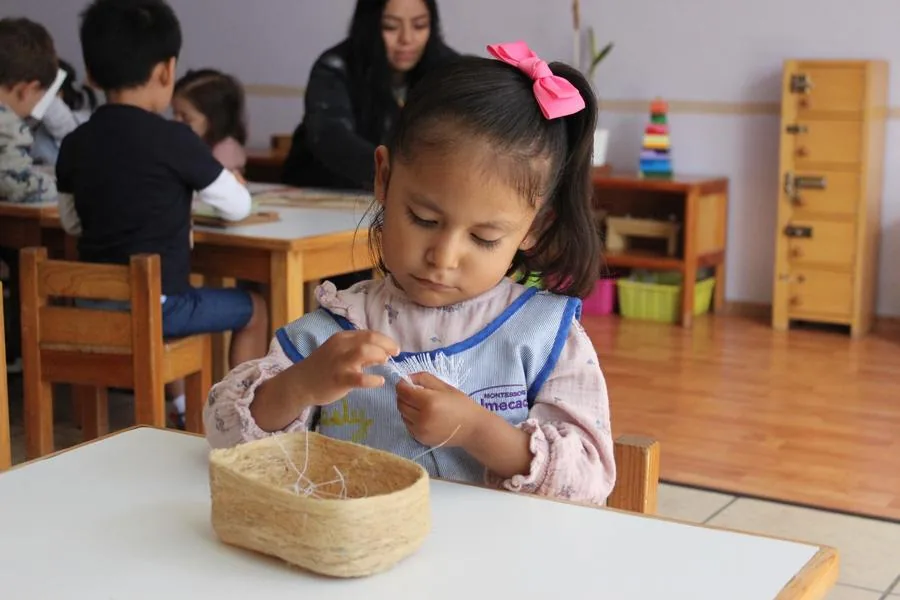
Cutting, pouring or weaving are practical life exercises that prepare the hands for writing.
What types of practical life activities are there?
| Category | Examples |
|---|---|
| Care of oneself | Buttoning, zipping up, tying shoes, washing hands, combing hair |
| Care of the environment | Sweeping, mopping, wiping a table, watering plants, folding cloths |
| Food preparation | Peeling a banana, cutting soft fruit, squeezing an orange, spreading bread |
| Grace and courtesy | Greeting, saying please, giving way, listening without interrupting |
| Control of movement | Walking along a line, carrying a tray, carrying a pitcher without spilling |
What practical life activities can I do at home?
You don't need special materials. These activities use common objects and can be offered to children from about 2 years old, always with supervision:
- Pour water from a small pitcher into a glass.
- Transfer beans or rice with a spoon from one container to another.
- Fold napkins or small cloths.
- Button and unbutton a garment on a frame or a shirt.
- Sweep with a child-sized broom and dustpan.
- Wipe the table with a damp cloth after eating.
- Water a plant with a small watering can.
- Squeeze oranges to make their own juice.
- Cut banana or cucumber with a table knife, with help.
- Set the table by placing plates and cutlery.
- Put away their clothes in a drawer within reach.
- Move objects with kitchen tongs.
How do I prepare the home for practical life?
- Offer a stable stool so they can reach the sink, the table or the kitchen counter.
- Choose real, small utensils: pitchers, thick glass cups, spoons and brooms sized for them.
- Use trays or baskets so each activity has everything it needs in one place.
- Keep objects within reach, on low shelves and always in the same place.
- Show the activity slowly and without talking, so the child can watch your hands.
- Let them repeat it until they decide to stop; it doesn't have to be perfect.
Common mistakes when doing practical life with children
- Correcting every movement instead of letting the material or repetition adjust it.
- Rushing them: the activity takes as long as it needs.
- Doing it for them to avoid mess. Mess is part of learning.
- Using fragile plastic objects or toys instead of real tools.
Safety first. Offer only activities that suit your child's age and stay close when they use sharp objects, hot water or small pieces.
Practical life at Montessori Calmecac
At Montessori Calmecac, practical life is part of the daily environment of toddler and preschool groups, together with the school garden, where children care for a living being and learn how a food is grown. You can see the environments on a visit.
Frequently asked questions
At what age does practical life begin? Once the child walks confidently, around 18 months to 2 years, with simple activities such as passing objects or cleaning. It becomes more complex with age.
Is it dangerous for my child to use real objects? With the right age, the right demonstration and supervision, children handle real, child-sized objects well. It is always best to stay nearby.
How long should each activity last? As long as the child decides. What matters is respecting their concentration and not interrupting them.
Does practical life help with writing? Yes, indirectly. Pinching, pouring, buttoning and cutting strengthen the hands and the coordination needed to hold a pencil.
MC Montessori Calmecac Team
A Montessori toddler and preschool in San Pedro Cholula, Puebla, with roots going back to August 2003. If you want to see how the method is experienced in a classroom, schedule a visit.