Quick answer
The absorbent mind is the ability of children from 0 to 6 years old to absorb the language, culture and customs of their surroundings effortlessly, like a sponge. Maria Montessori observed that this ability is accompanied by sensitive periods: stages in which the child has a special interest in learning something specific, such as order or language.
The essentials
- From ages 0 to 3, absorption is unconscious; from 3 to 6, it is conscious.
- Sensitive periods are windows of interest, not mandatory deadlines.
- What the child absorbs depends on the environment and the adults.
- Accompanying means observing, offering and respecting their pace.
In this article
- What is the absorbent mind according to Maria Montessori?
- What are the two stages of the absorbent mind?
- What are sensitive periods?
- How can I accompany my child during these periods?
- What does current science say about the first years?
- Frequently asked questions
What is the absorbent mind according to Maria Montessori?
Montessori observed that young children learn differently from adults: they don't study, they absorb. They learn to speak their mother tongue, to move, to tell what is correct in their culture, simply by living in that environment. That is why the environment and the people around the child are so important.
What are the two stages of the absorbent mind?
| Stage | Approximate age | How they learn |
|---|---|---|
| Unconscious absorbent mind | Ages 0 to 3 | Absorbs without realizing it: language, movement, order and customs |
| Conscious absorbent mind | Ages 3 to 6 | Absorbs actively: wants to do, repeat and perfect |
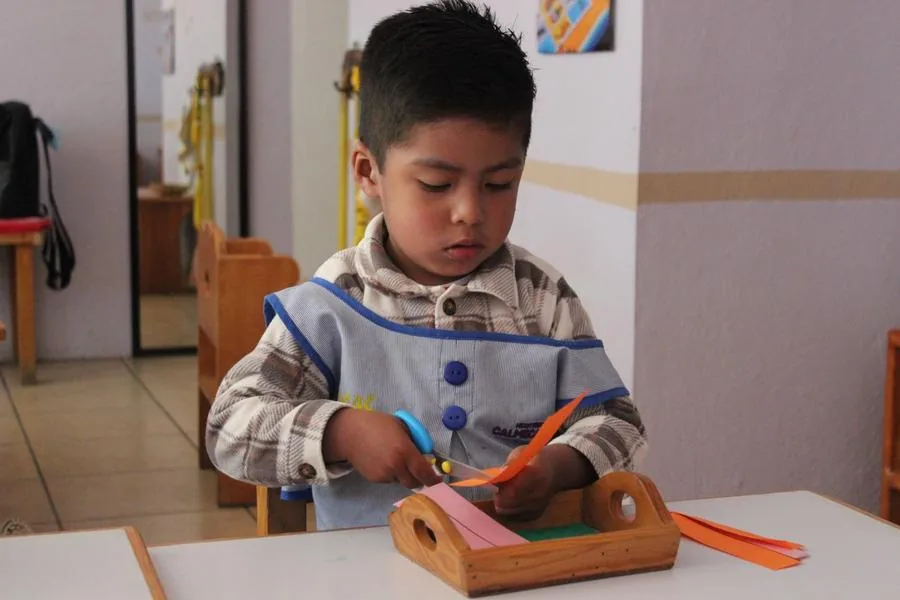
A child concentrating on what they are doing is going through a sensitive period.
What are sensitive periods?
These are stages in which the child shows an intense, natural interest in learning something specific. If they find an environment that supports it, that learning happens easily and joyfully. The ages are approximate and vary from child to child:
| Sensitive period | Approximate age | How you notice it |
|---|---|---|
| Order | Ages 1 to 3 | Changes bother them; they want everything in its place |
| Language | Ages 0 to 6 | Repeats words, asks about everything, is interested in sounds |
| Movement | Ages 1 to 4 | Walks, climbs, carries, wants to move all the time |
| Refinement of the senses | Ages 2 to 6 | Touches, smells, compares textures and sounds |
| Social aspects | Ages 2 to 6 | Observes, imitates and looks to spend time with other children |
How can I accompany my child during these periods?
- Observe what interests them right now: ordering, jumping, asking questions, touching.
- Offer objects, activities and words related to that interest.
- Keep stable routines that give them security and order.
- Talk to them using precise vocabulary, without baby talk.
- Don't rush them or compare them with other children: each one has their own pace.
What does current science say about the first years?
Current research on child development agrees that the first years are a time of great brain plasticity and that experiences, loving relationships and the environment strongly influence learning. This does not mean pressuring children, but looking after the quality of the environments and relationships in which they grow up.
Frequently asked questions
What happens if a sensitive period passes? It is not final. Sensitive periods are moments of special ease, but the child can keep learning afterward, with a different kind of effort.
Does the absorbent mind mean I should stimulate my child all the time? No. What they need is a calm environment, present adults and free time to explore. Too much stimulation can be counterproductive.
At what age does the absorbent mind end? Around age 6, according to Montessori, the child moves to a more reasoned way of learning and becomes interested in knowing the why of things.
How is the absorbent mind applied in a Montessori school? With prepared environments, concrete materials, adults who model language and respect, and a lot of freedom of movement.
MC Montessori Calmecac Team
A Montessori toddler and preschool in San Pedro Cholula, Puebla, with roots going back to August 2003. If you want to see how the method is experienced in a classroom, schedule a visit.