Quick answer
Montessori materials are objects designed so that children learn by handling concrete concepts. Each one isolates a single quality, such as size, texture or quantity; it is attractive; there is only one of each kind; and it lets the child detect for themselves whether they made a mistake, which is called control of error.
The essentials
- Each material works on a single idea at a time.
- They move from the concrete to the abstract.
- They have control of error: the child self-corrects.
- They are organized by areas: practical life, sensorial, language, math and culture.
In this article
- What are Montessori materials?
- What characteristics does a Montessori material have?
- What are the best-known Montessori materials?
- How does a material work on the inside? The pink tower example
- Why are Montessori materials made of wood and one color?
- Do I need to buy Montessori materials for home?
- Frequently asked questions
What are Montessori materials?
They are learning tools that Dr. Maria Montessori designed and refined by observing children. They are not toys: each one has a clear pedagogical purpose and is designed so that the child works by themselves.
What characteristics does a Montessori material have?
- It isolates one quality. The pink tower, for example, only varies in size; everything else (color, shape, texture) is the same.
- It has control of error. The material itself shows the child if something has been put in the wrong place.
- It is attractive. Materials such as wood, glass or fabric, kept orderly and in good condition, invite work.
- It moves from the concrete to the abstract. First it is touched and compared; then the concept is understood.
- There is only one of each kind. This teaches waiting for turns and caring for the material.
Concrete material lets the child touch and compare what they will later understand in an abstract way.
What are the best-known Montessori materials?
| Material | Area | What it works on |
|---|---|---|
| Pink tower | Sensorial | Ten cubes of increasing size: visual discrimination of dimensions |
| Brown stair | Sensorial | Prisms of different thickness: comparing and ordering by size |
| Red rods | Sensorial | Ten rods of increasing length: notion of length |
| Knobbed cylinders | Sensorial | Pieces that fit into their holes: size and control of error |
| Sandpaper letters | Language | Letters in sandpaper to trace with a finger and associate sound and symbol |
| Moveable alphabet | Language | Loose letters to form words before writing with a pencil |
| Number rods | Math | Quantities from 1 to 10 in length, to understand each number |
| Golden beads | Math | Units, tens, hundreds and thousands in concrete form |
How does a material work on the inside? The pink tower example
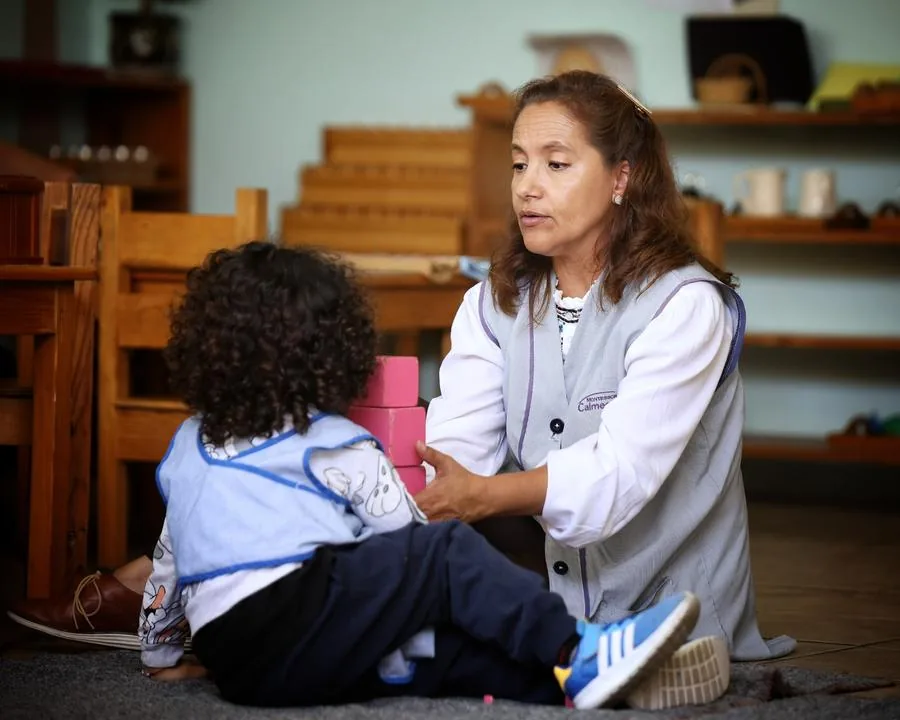
The pink tower is made up of ten cubes of the same color, ranging from 1 cm to 10 cm per side. The child takes them out one by one, stacks them from largest to smallest and discovers on their own that if they make a mistake the tower does not stand straight. Without anyone explaining it, they are working on comparing sizes, coordination and concentration.
Why are Montessori materials made of wood and one color?
By removing colors and distracting stimuli, the child concentrates on the quality being worked on. Wood, glass or textiles are real materials, pleasant to the touch, that invite the child to handle the object with care.
Do I need to buy Montessori materials for home?
No. The most important thing is not the material but the environment and attitude: an orderly space, real objects within reach and time to repeat. At home you can offer trays with beans and spoons, jars with screw-on lids or cards to sort, without buying anything specialized.
Frequently asked questions
What is control of error? It is a characteristic of the material that lets the child realize for themselves that they made a mistake, without an adult pointing it out. This develops autonomy and confidence.
Why is there only one of each material in the classroom? So that children learn to wait, respect each other's turn and take care of what they use. It also helps keep the environment orderly.
Are Montessori materials only for schools? They were designed for prepared environments, but many activities can be adapted at home with everyday objects.
At what age are they used? It depends on the material. Practical life materials are used from about age 2, and language and math materials are usually introduced from age 3, following each child's pace.
MC Montessori Calmecac Team
A Montessori toddler and preschool in San Pedro Cholula, Puebla, with roots going back to August 2003. If you want to see how the method is experienced in a classroom, schedule a visit.