Quick answer
In Montessori, discipline comes from within. Freedom within limits means that children can choose their activity, move around and decide how to use their time, always within clear rules of respect for people, materials and the environment. With that combination, children build self-discipline instead of obeying out of fear or for a reward.
The essentials
- Freedom is not doing whatever you want: it is choosing within clear limits.
- Limits are few, firm and consistent.
- Control of error teaches children to correct themselves without depending on an adult.
- Concentration and repetition form inner discipline.
In this article
- What does freedom within limits mean?
- How is self-discipline formed?
- How do I set limits at home the Montessori way?
- Does Montessori use rewards and punishments?
- What role do grace and courtesy play?
- Frequently asked questions
What does freedom within limits mean?
Young children need freedom within the safety of clear limits, guided in an environment of love and trust. Freedom to choose, move and explore; limits so that this freedom does not affect others or the space.
- They can choose their work, but must use it carefully.
- They can move around the classroom, but they walk within the environment.
- They can repeat an activity, but they respect others' turns.
How is self-discipline formed?
- Choice: the child chooses among options suited to their age.
- Concentration: by working on what interests them, they stay longer with an activity.
- Repetition: repeating gives them mastery and confidence.
- Control of error: the material shows them whether they made a mistake and they can correct it on their own.
- Responsibility: they put away the material, care for the environment and help others.
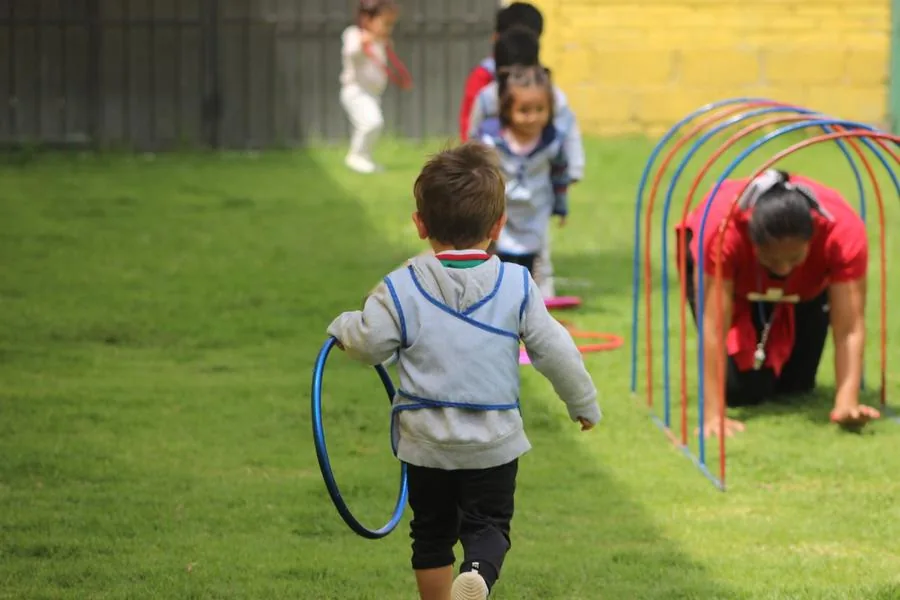
Free movement in the garden, with clear rules of care and respect.
How do I set limits at home the Montessori way?
| Instead of… | Try… |
|---|---|
| "Don't run." | "Inside the house we walk; in the garden you can run." |
| "Don't touch that." | "This is fragile. Here is something you can use." |
| "Hurry up!" | "We have 5 minutes. What do you still need to finish?" |
| "I'm going to take the toy away." | "When you use the toy carefully, you can keep playing." |
Giving two valid options, speaking calmly and keeping limits consistent helps the child feel safe.
Does Montessori use rewards and punishments?
No. The method aims for motivation to be internal: the child works because they enjoy it and feel capable. Consequences are natural and logical (if water spills, it gets wiped up), without humiliating or threatening.
What role do grace and courtesy play?
It is part of practical life: learning to greet, ask for a favor, wait for a turn or apologize. Children learn it by watching adults and practicing with small everyday exercises.
Frequently asked questions
Is Montessori a permissive method? No. Limits are clear and firm. The difference is that they are explained with respect and focus on what can be done.
What do I do if my child doesn't respect a limit? Stay calm, repeat the limit in few words and offer an alternative. Consistency is what teaches.
How does control of error help with discipline? Because the child discovers for themselves when something didn't turn out right and tries again, which strengthens persistence and reduces dependence on the adult.
Does it work with very restless children? Yes. Making room for movement and purposeful activities helps channel energy. Each child needs their own time to find their rhythm.
MC Montessori Calmecac Team
A Montessori toddler and preschool in San Pedro Cholula, Puebla, with roots going back to August 2003. If you want to see how the method is experienced in a classroom, schedule a visit.