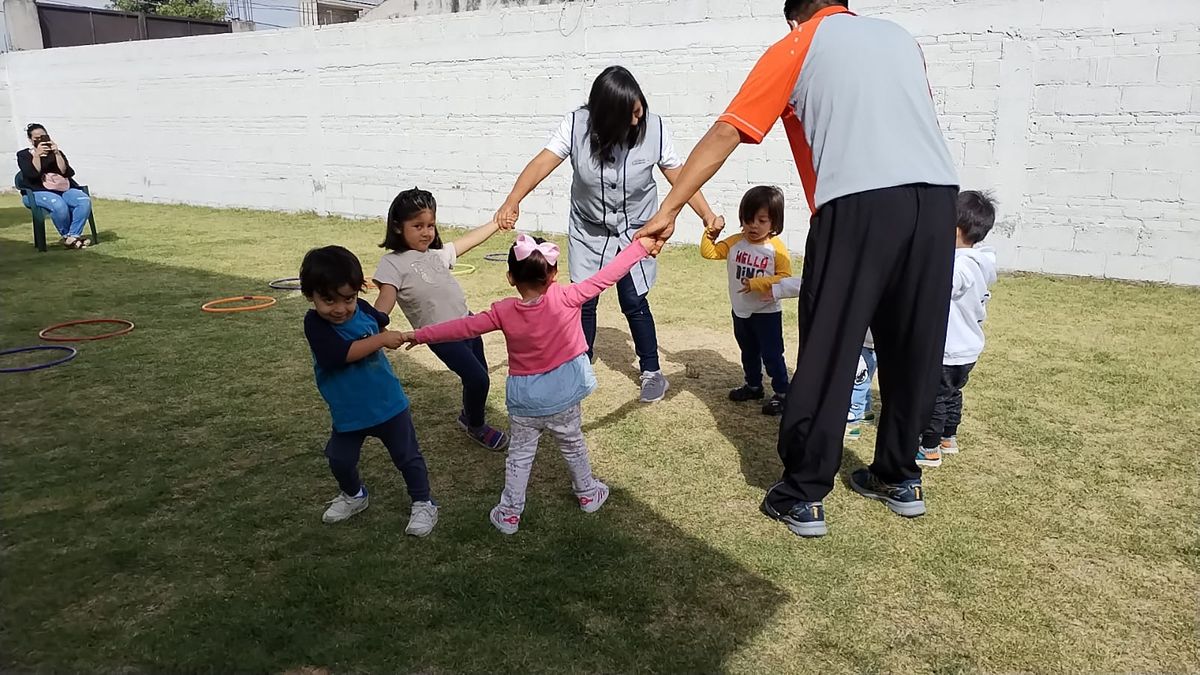
In Montessori schools, the topic of "courtesy" toward others takes up an important part of the curriculum: "GRACE AND COURTESY." It is common in the classroom to show children how to greet their classmates and say goodbye at the end of activities, how to interrupt when someone is speaking, how to politely say "no, thank you," how to apologize sincerely and how to resolve conflicts peacefully.
Our example as adults is also more powerful than anything we can say, so parents and older siblings should act accordingly. Children absorb everything that happens in their immediate surroundings and will soon act just like us.
Motor skills
Below are some important aspects of putting "grace and courtesy" into practice:
- Part of the goal of grace and courtesy lessons is to "Help life"
- The intellect allows us to "know," the will allows us to "choose." These potentials are present as attributes at birth, and as these human attributes develop, Grace and Courtesy become a human responsibility.
- Socialization: shaping societies capable of cooperating, serving, sharing and living in harmony. Grace and courtesy is a transcendental value in the creation and maturation of the human being; only if adults give it to the child will the child become a complete expression of the human being and of their responsibility in creation.
- Definition taken from the courtesy dictionary: kind and considerate conduct or acts. We are not the ones who are going to receive consideration; the other person is, and our consideration has to be for them.
- Maria Montessori: "To do an action gracefully, it is not enough to do it with a smile on your face."
- Maria Montessori adds: "To make the gracious act, considered the fine flower of charity, the smile has to be in the heart; the act has to be an act of love, one for which we are responsible, an act of will."
- Acts of Grace and Courtesy are not responsible human acts unless knowledge of them has been given to the intellect and the will has received the challenge of choosing to act with grace. The development of all human responsibility depends on education, and on the education of Grace and Courtesy. Love and service to others begin the moment the child is born, so the first ones responsible for this are the parents. They are responsible for the prepared environment in which the child can absorb Grace and Courtesy; the adult must set the example.
- Let us remember the maxim: "Treat others as you would like to be treated."
- If we always put the "I" at the center, there is no place for other people, because "I" must come first. No matter the movement, communication does not work: "I" hog the stage, "I" am in the middle, and "Grace and Courtesy" cannot happen because there is no room for love, for caring, for the good of the other.
- "Grace and Courtesy exercises" cover all the elements that allow the child to feel comfortable in their dealings with others, so that the child knows how to act in social situations.
- It is not something to keep the child busy; it is an important part of Montessori education and is absolutely essential if human society wants to recover civilized behavior with the code of "gentlemanliness" as the norm.