Quick answer
In Montessori, cognitive learning is organized into three areas: language, math and culture. Children learn with concrete materials, first touching and comparing and then abstracting. They write before they read, understand quantities before using numbers and explore the world with maps, nature, art and music.
The essentials
- Cognitive learning is divided into language, math and culture.
- Children learn with concrete materials, moving from the tangible to the abstract.
- Each child reads, writes and counts when they are ready.
- At home, you can support it with conversation, books and objects to count.
In this article
- What does cognitive area mean in Montessori?
- How do children learn to read and write in Montessori?
- How is math taught with concrete materials?
- What is the culture area in Montessori?
- How can I support cognitive development at home?
- Frequently asked questions
What does cognitive area mean in Montessori?
The method does not use a single label, but three areas where children build their thinking: language, math and culture (geography, science, nature, art and music). All of them rest on practical life and on the sensorial area, which prepare the hand, the mind and attention.
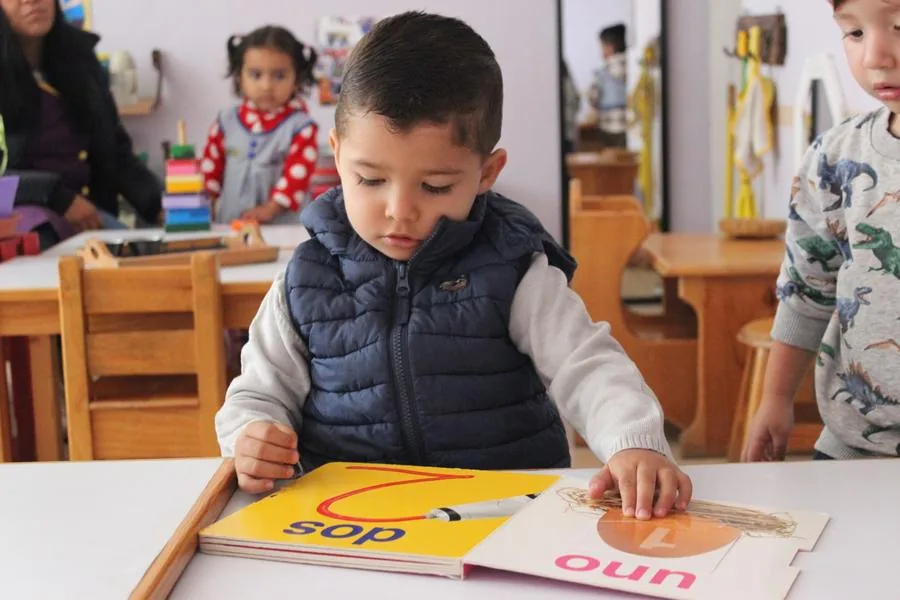
Tracing and drawing with the hands prepares writing long before the pencil.
How do children learn to read and write in Montessori?
Language is built in stages. First, oral language is enriched with conversation, rhymes and vocabulary. Then come the sounds, before the names of the letters, and the sandpaper letters, which the child traces with a finger while repeating the sound.
- Oral language: conversation, songs, stories and precise vocabulary.
- Sounds and sandpaper letters: the child touches, traces and says the sound.
- Moveable alphabet: they form words with loose letters, with no need for a pencil.
- Writing and reading: they arise naturally when the child is ready, generally writing before reading.
How is math taught with concrete materials?
Children first handle quantities and then represent them with symbols. The number rods let them understand the value of each number from 1 to 10; the golden beads show units, tens, hundreds and thousands in concrete form.
| Stage | What the child does | Typical material |
|---|---|---|
| 1. Quantity | Counts and compares real quantities | Number rods, objects to count |
| 2. Symbol | Connects the quantity with the written number | Sandpaper numerals, number cards |
| 3. Decimal system | Understands units, tens and hundreds | Golden beads |
| 4. Operations | Adds and subtracts with materials before abstracting | Boards and beads |
What is the culture area in Montessori?
It covers everything that helps the child understand the world: geography with maps and continent puzzles, natural science, botany and zoology, history through timelines, and also art and music. In a school with a garden, like Montessori Calmecac, contact with plants and growing food is part of this experience.
How can I support cognitive development at home?
- Talk a lot. Name objects, describe what they see and answer their questions with precise vocabulary.
- Read every day. Picture books, rhymes and stories strengthen language.
- Count with real objects: spoons, fruit, steps while walking.
- Offer experiences with nature: going out to the garden, planting, watching insects.
- Respect their pace. There is no exact age to read or add.
Frequently asked questions
At what age do Montessori children read? There is no fixed age. Each child progresses when they are ready. In general, writing appears before reading, and both emerge after prior work with sounds and sandpaper letters.
Do Montessori children memorize the multiplication tables? First they understand each operation with concrete materials, and then, once they understand it, they memorize it. The order is to understand first and memorize afterward.
What if my child doesn't show interest in letters yet? That is normal. Continue with conversation, reading aloud and games with sounds. Each child has their own time.
Is English learned within these areas? Yes. In a bilingual environment, English coexists with language, math and culture within the day's activities.
MC Montessori Calmecac Team
A Montessori toddler and preschool in San Pedro Cholula, Puebla, with roots going back to August 2003. If you want to see how the method is experienced in a classroom, schedule a visit.