Quick answer
The prepared environment is a space designed so that children can move, choose and work on their own. It has order, beauty, child-sized furniture, materials on open shelves and clear areas. It is called "prepared" because the adult organizes it with intention to respond to the developmental needs of each stage.
The essentials
- Everything is at the child's height and within their reach.
- Order lets the child know where everything is.
- There are fewer objects, but they are high quality and have a purpose.
- At home, it can be applied room by room.
In this article
- What is the prepared environment in Montessori?
- What are the characteristics of a Montessori classroom?
- How does it differ from a traditional classroom?
- How do I create a prepared environment at home?
- Common mistakes when preparing the environment at home
- Frequently asked questions
What is the prepared environment in Montessori?
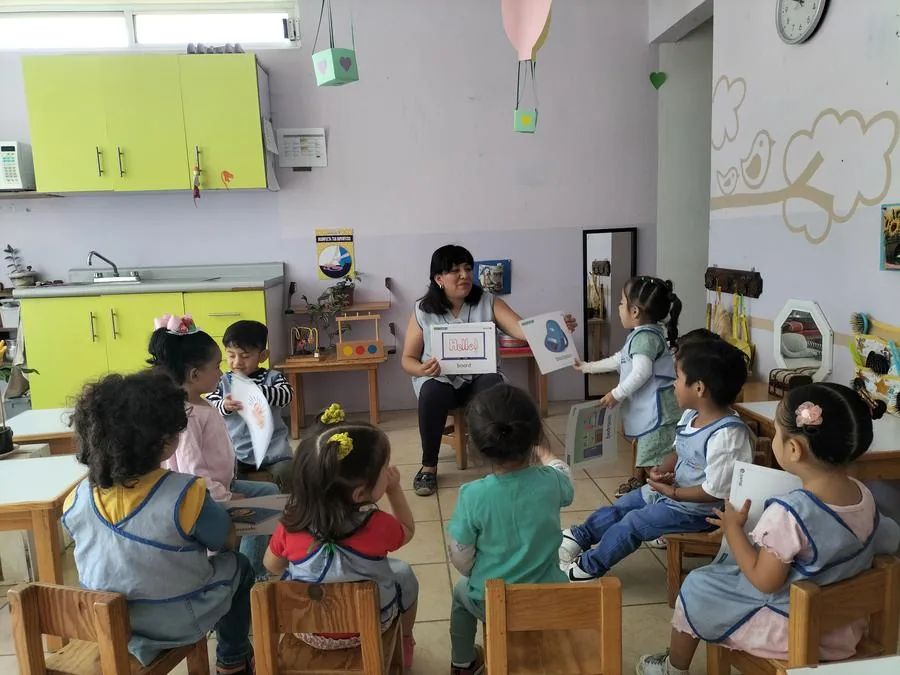
It is the classroom, the garden and every object in them, organized so that the child is the protagonist. The guide prepares it every day, observes how the children use it and adjusts it according to what they need. In the Montessori method, the environment is an essential part of learning, together with the guide and the other children.
Child-sized tables, chairs and shelves let children work independently.
What are the characteristics of a Montessori classroom?
- Order. Each material has its place and is returned there when finished.
- Beauty. Soft colors, plants, natural light and quality materials invite calm work.
- Scaled furniture. Tables, chairs, sinks and shelves at the child's height.
- Materials within reach. Open cabinets organized by area: practical life, sensorial, language, math and culture.
- Freedom of movement. Children can walk, change places and work at a table or on a mat.
- Contact with nature. Plants, a garden or a school garden are part of the environment.
How does it differ from a traditional classroom?
| Traditional classroom | Montessori environment | |
|---|---|---|
| Furniture | Desks in rows, facing the front | Tables and mats in different parts of the room |
| Materials | Kept by the teacher | On open shelves within the child's reach |
| Activity | The same for the whole group | Chosen by each child |
| Adult's role | Leads the class | Observes, presents and guides |
| Ages | A single grade | Mixed ages within the stage |
How do I create a prepared environment at home?
You don't need to remodel. With small changes you can give your child more independence in every space:
| Space | Simple change |
|---|---|
| Their room | A low bed or a mattress on the floor, clothes within reach, a low shelf with a few quality books and toys |
| The kitchen | A small stool or learning tower, everyday cups and plates in a low drawer, a small pitcher |
| The bathroom | A stool for the sink, towel and toothbrush at their height, a low mirror |
| The entrance | Low hooks for their backpack and coat, a place for their shoes |
| The living room | A shelf or basket with activities they can choose and put away on their own |
Golden rule. Less is more: offer a few well-organized objects and rotate them from time to time according to their interests.
Common mistakes when preparing the environment at home
- Filling the space with toys. Too many options make it hard to concentrate.
- Using objects the child cannot reach or handle alone.
- Changing everything every week: the child needs order and consistency.
- Thinking the environment does everything. The adult's attitude is just as important.
Frequently asked questions
Is it necessary to buy Montessori furniture? No. A stable stool, a low shelf and hooks at their height are enough to start. What matters is that the child can reach and use their things.
Why are there few toys in a Montessori environment? Because having a few well-organized, quality options makes it easier for the child to choose and concentrate.
How many materials should a shelf at home have? Enough to offer between 5 and 8 options at a time. You can rotate them according to what interests them at the moment.
Can it be applied to children under 2 years old? Yes. For babies and toddlers, it means a safe space to move freely, objects they can explore and stable routines.
MC Montessori Calmecac Team
A Montessori toddler and preschool in San Pedro Cholula, Puebla, with roots going back to August 2003. If you want to see how the method is experienced in a classroom, schedule a visit.